
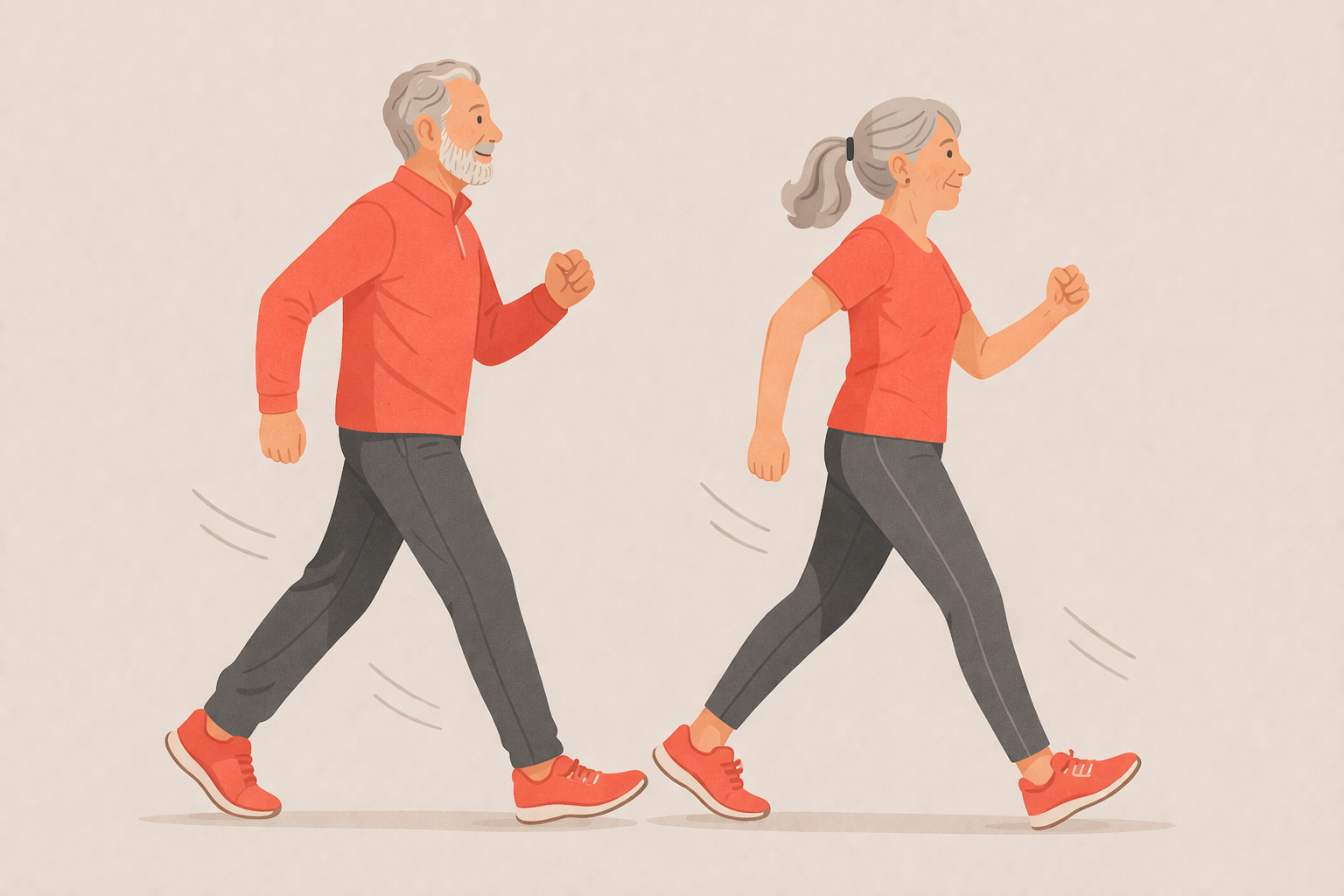
Getting started with the Japanese Walking Method
You've likely heard about the Japanese Walking Method: walk briskly for three minutes, walk at a relaxed pace for three minutes, and repeat that cycle five times. (If you haven't read about it yet, you can read about it here.)
It's a simple routine, and it can absolutely be beneficial for seniors. The key study behind the method had participants who were, on average, in their early 60s, and they saw real improvements in leg strength, cardiovascular fitness, and blood pressure (Nemoto et al., 2007).
Here are some things to keep in mind before starting.
Before starting any new fitness routine, it's a good idea to check with your healthcare provider to make sure it's right for you.
Start easier than you think
"Brisk walking" means different things to different people. Regardless of how you define it, if you feel dizzy, panicky, or completely unable to talk, that's a sign to slow down.
Pick a pace that feels challenging but manageable, and that's your starting point.
If the intervals feel too long at first, you don't need to start with the full three minutes. Try two minutes of easy walking followed by two minutes at a slightly faster pace. If you're just starting out, you can even spend the first week or two walking at one steady, moderate pace just to build the habit.
Protect your joints
When you pick up the pace, the impact on your knees, hips, and ankles goes up too. That's normal. One thing that can help: instead of taking longer steps to go faster, try taking shorter, quicker steps.
Longer strides put more stress on your joints. Keeping your steps slightly shorter than your natural stride when you speed up is easier on the body. Think quicker steps, not bigger ones.
With each step, let your heel touch down first, then roll your weight gradually along your foot toward the ball and push off through your toes. Think of it like slowly peeling your foot off the ground from heel to toe. The smoother that roll, the less jarring force goes through your joints.
If joint health is a concern, choose flat, even surfaces for your walks. A paved path, a track, or even a hallway works well. Shoes with good arch support and cushioning make a difference too.
Stay steady on your feet
The upright posture that comes with this method can actually help your balance over time. But during the faster intervals, any balance issues you have will show up more clearly.
If you've ever felt unsteady on your feet, start on flat, well lit, predictable routes. A track, a mall corridor, or a treadmill with rails are all good options.
Something to be aware of: as you get tired toward the end of a session, your balance may not feel as sharp as it did at the start. Consider starting with shorter sessions and building up from there.
Technique that makes a difference
You don't need perfect form to benefit from this method, but a few small adjustments go a long way.
Keep your gaze forward, not down at your feet. It feels natural to look down, especially when you're focused on your pace, but looking ahead helps your posture and your balance at the same time.
Relax your shoulders and keep a slight engagement in your core. Think of gently bracing your midsection, like you're about to laugh. That small activation protects your lower back and keeps you more stable.
Use your arm swing as a throttle. Instead of only pushing harder with your legs to speed up, try a slightly bigger, quicker arm swing. To slow down, make it smaller and calmer. Your arms and legs naturally want to sync up, so this is an easy way to control your pace without overthinking it.
And don't skip the warm-up and cool-down. Three to five minutes of easy walking and some gentle ankle and hip movements before you start, and the same to wind down at the end, can make a real difference. You'll feel less sore the next day and your body will adjust to the effort more smoothly.
How to build up over time
The research behind this method had people doing at least 30 minutes of intervals four days a week. That doesn't mean you have to start there.
Start at whatever interval length and pace feels comfortable for you. If three-minute cycles are too much, try one or two minutes instead. The key is getting into the rhythm of alternating between slower and faster. From there, you can slowly add more each week.
As an example:
Weeks one and two: Walk for 20 minutes total, with two or three interval cycles. Keep the speed difference modest.
Weeks three and four: Extend to around 25 minutes or add another cycle. Stay within an effort level that feels challenging but manageable.
Once that feels comfortable on most days, then you can consider pushing toward 30 minutes or picking up the pace on your brisk intervals.
And consider finding a walking buddy or a group. Having someone alongside you helps you stay consistent and makes the whole thing more enjoyable.